The notebook that feels too good to use stays empty. It sits on the shelf, acquiring the particular guilt of objects that were purchased with intention and then carefully avoided. The cover is still clean. The spine has never cracked. The first page is still blank, because the first page has to be right, and nothing has been right enough yet.
The fix is immediate, slightly violent, and permanent.
Ruin the first page.
Write something bad on it. Write your name in ugly handwriting. Write the date and a sentence about what you had for breakfast, or write “this notebook is now ruined” and sign it. The specific content is irrelevant. What matters is that the standard has been broken, and there is nothing left on the page worth protecting.
The perfection of a blank page is a trap the object sets without meaning to. The resistance lives entirely in the writer, who has confused an aesthetic response — the clean cover, the crisp paper, the smell of a new spine — with a standard of entry. There is no standard of entry. The notebook is a tool, and tools ask to be used badly before they are used well.
✦ ✦ ✦Every serious writer who has talked honestly about process has arrived at the same confession. In Bird by Bird (1994), Anne Lamott describes the first draft as “the child’s draft, where you let it all pour out and then let it romp all over the place, knowing that no one is going to see it and that you can shape it later.” The first draft earns its existence precisely by being unguarded. The guard is the problem. The guard is what the blank first page assembles.
“Almost all good writing begins with terrible first efforts. You need to start somewhere.”
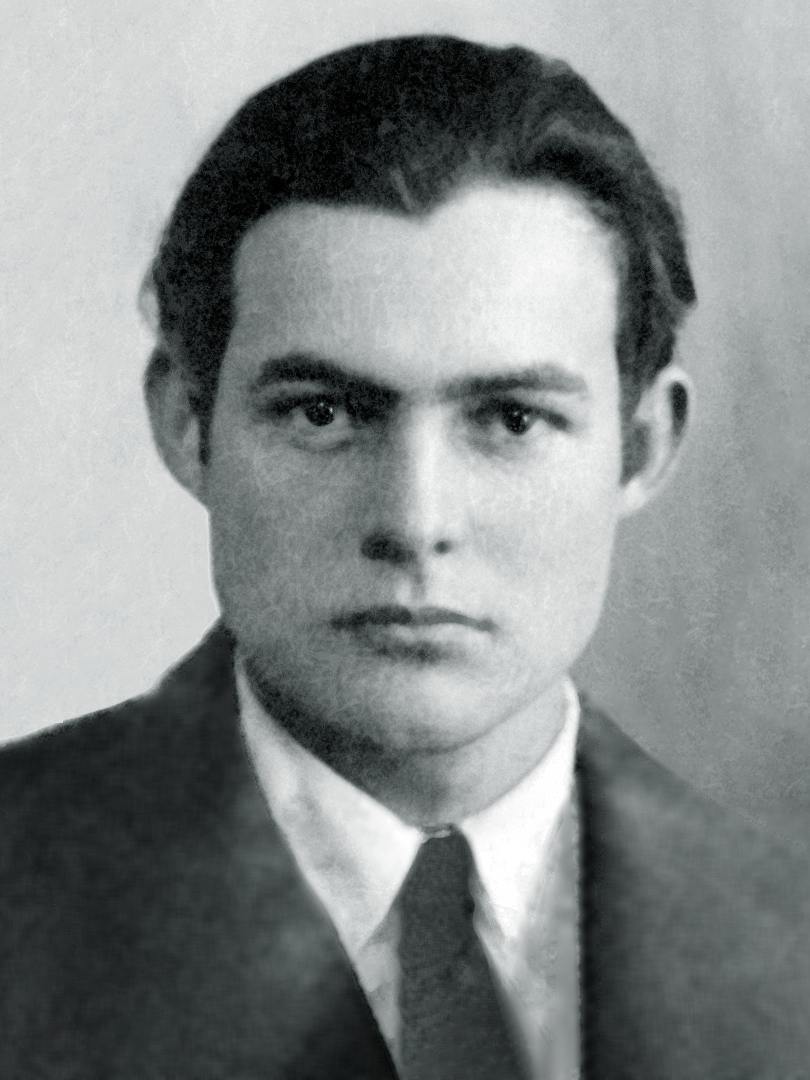
— Anne Lamott, Bird by Bird, 1994Ernest Hemingway rewrote the final page of A Farewell to Arms forty-seven times. This is documented fact — the alternative endings are held at the John F. Kennedy Presidential Library in Boston, and a 2012 edition of the novel published all of them. In a 1958 interview with The Paris Review, Hemingway said he rewrote the ending because he was having difficulty “getting the words right.” What that means, in practice: one of the most accomplished prose writers of the twentieth century sat down to write a last page, wrote something inadequate, wrote it again, wrote it forty-five more times, and only then had what he needed. The forty-seven drafts were not failures preceding the success. They were the work.
The same principle holds for a notebook page. The first entry is not the price you pay for the entries that follow. It is the first entry, with everything that implies — rough, provisional, subject to revision, and necessary.
✦ ✦ ✦There is a reason the paralysis in front of a blank notebook page feels different from the paralysis in front of a blank document on a screen. The notebook is physical. You can see it from across the room. It carries the weight of its own blankness as a reproach. The screen, when closed, disappears. The notebook, on the shelf, does not.
Psychologists who study what they call maladaptive perfectionism — the kind that produces procrastination rather than quality — have identified a specific mechanism: delay as self-protection. As long as the notebook is unopened, it cannot fail. The idea inside the writer’s head remains intact, perfect, unattempted. The moment the pen touches the page, that perfection is at risk. So the pen stays off the page, and the notebook stays on the shelf, and the ideas stay where they cannot be judged.
“You can always edit a bad page. You can’t edit a blank one.”
— Jodi PicoultThe editing, the return, the revision — all of it requires something to exist first. The first page of a notebook is that something. Its quality is beside the point. Its existence is the entire point.
✦ ✦ ✦Writers talk about the first draft as something to be survived rather than constructed. The same logic applies here. The first page of a notebook is not the place where the good ideas go. It is the place where the act of using the notebook begins — and that act, once begun, does not require the same activation energy to continue. The second page is easier than the first. The third easier than the second. By the time you reach the page where you write something that surprises you, the first page is twenty, thirty pages behind you, already unremarkable, already just paper.
This connects to something worth reading about separately: the discipline of catching thoughts first and editing them later is a different skill from starting, but it depends on starting. You cannot catch what you never threw down.
The notebook that feels too good to use is the notebook that will never be used. And the notebook that is never used is not a beautiful object. It is a small, expensive failure.
Ruin it. Start there.
References
- Lamott, A. (1994). Bird by Bird: Some Instructions on Writing and Life. Pantheon Books.
- Hemingway, E. (1929/2012). A Farewell to Arms (Hemingway Library Edition). Scribner.
- Hemingway, E. (1958). Interview with George Plimpton. The Paris Review, No. 18.